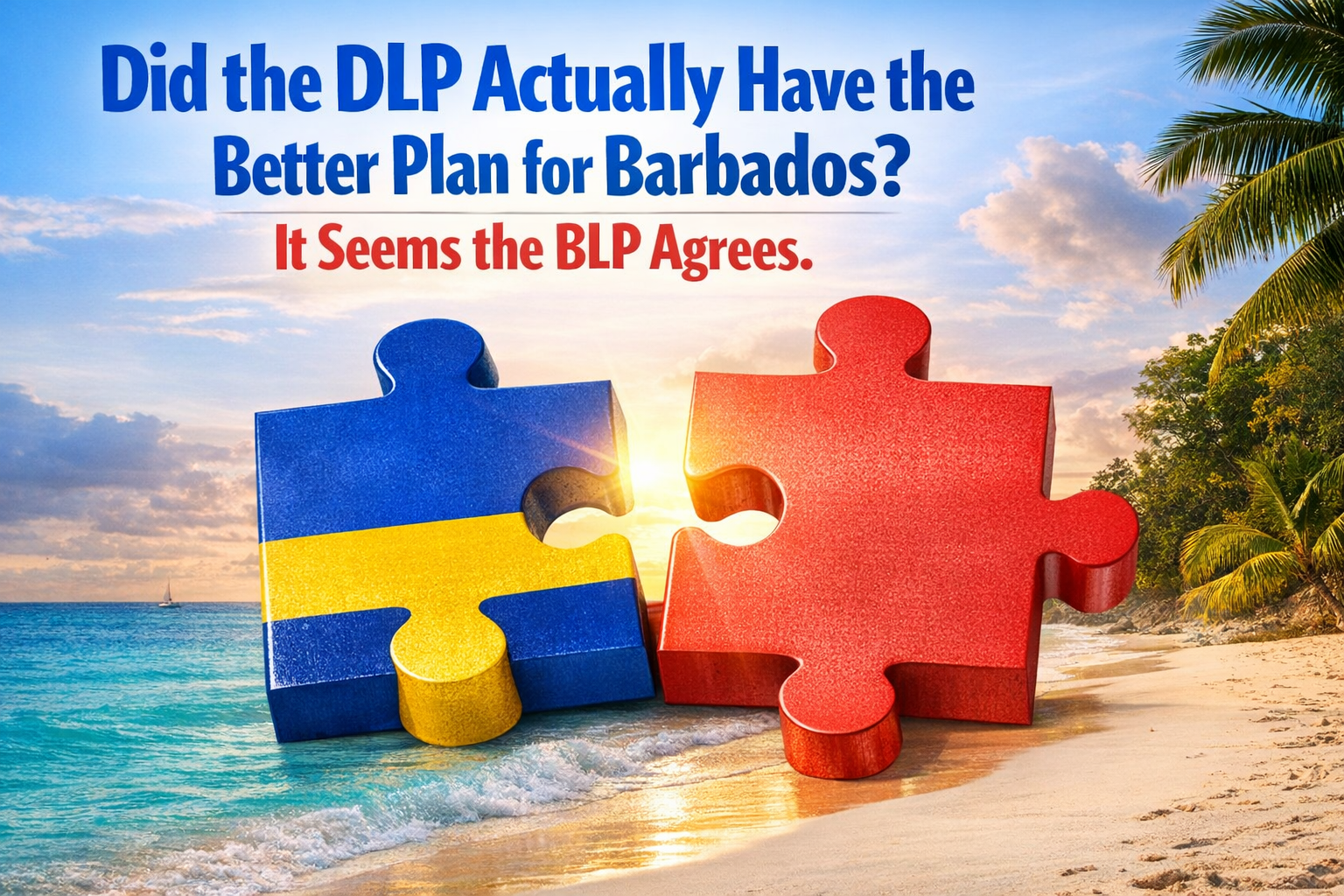
**Did the DLP Actually Have the Better Plan for Barbados?
It Seems the BLP Agrees.**
When Barbados went to the polls on February 11, 2026, the political noise of the campaign season painted the Democratic Labour Party’s (DLP) 2026 Contract as unrealistic, uncosted, or out of touch. Yet, only weeks after the election, a curious pattern has emerged:
The very policies the BLP criticized are now showing up—sometimes almost identically—in the BLP’s own governance plans and early public actions.
This raises a fair question:
Did the DLP actually have the more technically sound, forward‑thinking plan for Barbados—one so strong that the BLP is now quietly adopting key elements of it?
Let’s examine the evidence.
**1. Targeted Cost‑of‑Living Relief:
DLP Vision First, BLP Implementation After**
During the campaign, the DLP proposed a clear economic philosophy:
- Relief must be direct, targeted, and measurable
- Not dependent on retailers “passing down savings”
- Protect low‑ and middle‑income households with structural supports
[blp.org.bb]
Interestingly, though the BLP dismissed the DLP’s VAT approach before the election, once re‑elected, Prime Minister Mottley rolled out a package of supports that mirror the DLP’s underlying strategy:
- $100 monthly cost‑of‑living credit for pensioners, welfare recipients, and vulnerable households [barbadostoday.bb]
- Increase to the Reverse Tax Credit from $1,300 → $1,700
- New $750 credit for middle‑income earners ($25k–$35k) [associatestimes.com]
- Income tax refunds for workers earning up to $50,000 per year [associatestimes.com]
This is precisely the kind of direct household relief the DLP championed.
The BLP rejected the DLP’s talk—but adopted the DLP’s logic.
**2. Education Transformation:
BLP Rolling Out DLP’s Structural Blueprint**
The DLP Contract laid out the most comprehensive education reform Barbados has seen in years:
- Early screening for children ages 1–5
- Continuous assessment (not exam‑only placement)
- Upgraded school infrastructure & repair cycles
- Teacher development and inclusion systems
[blp.org.bb]
Weeks later, the BLP government’s own announcements look strikingly familiar:
- Continuous assessment begins September 2026, moving to a 50/50 model by 2028 (continuous assessment + exam scores) [nationnews.com]
- 66 primary schools refurbished, with 35 more scheduled—exactly aligned with the DLP’s year‑round maintenance model [nationnews.com]
- Major teacher training and governance modernization initiatives now underway
Though the BLP frames these measures differently, the structure, sequencing, and policy logic mirror the DLP’s approach almost point‑for‑point.
**3. Food Security & Local Production:
BLP Shift Echoes DLP’s “Produce or Perish” Strategy**
The DLP Contract featured a bold, unapologetic argument:
Barbados must adopt mandatory local sourcing targets
to protect food security and reduce import dependence.
The DLP proposed:
- A 50% → 80% local sourcing mandate
- Strengthened agro‑processing
- Industrial policy around food security
[blp.org.bb]
What is the BLP now prioritizing?
According to their 2026 manifesto and subsequent reporting:
- Food security and local production resilience are central pillars of their governing agenda
- Structural changes to supply chains and domestic outputs are now described as urgent national priorities
[writeups24.com]
It may not be labeled “Produce or Perish,” but it is, in practice, the same direction, with similar policy levers.
**4. Social Protection:
BLP Now Using the DLP’s Model of Predictable, Recurring Support**
The DLP Contract re-emphasized predictable, recurring support—not ad‑hoc measures or “one‑off gifts.”
[blp.org.bb]
And what has the BLP now embraced?
- Monthly, recurring payments for seniors and welfare recipients
- Structural tax credit reforms that create predictable annual income boosts
[associatestimes.com]
This is exactly the “steady and measurable” support system the DLP pitched.
**5. Housing & Public Service Modernisation:
BLP Priorities Mirror DLP’s Framework**
The DLP Contract laid out clear approaches to:
- Public service professionalisation
- Transparent governance and service delivery
- Housing affordability through structured policy reforms
[blp.org.bb]
The BLP’s 2026 manifesto echoes this with plans to:
- Regrade public service jobs
- Expand training and digital transformation
- Modernize public housing and public sector governance
[barbadospo…ypulse.com]
Again: different branding; same underlying architecture.
So What’s Really Going On?
This is the pattern:
- During the campaign, the BLP framed the DLP manifesto as unrealistic.
- After the election, the BLP began rolling out policies that look strikingly like DLP proposals.
- Why?
Because once the political noise died down, the BLP faced the same economic and social realities the DLP evaluated when drafting their Contract.
And the truth is:
👉 The DLP produced a technically structured, deeply researched, future‑focused plan.
👉 The BLP—despite winning every seat—appears to recognize the value in that plan.
Politics is performance.
Policy is reality.
In reality?
Barbados needs the kind of structural, accountable, people‑centered policy architecture the DLP put forward.
And based on their own actions, the BLP seems to agree.
Final Thought
The question heading into 2026 was:
Which party had the better plan?
But the question emerging in 2026 after the election is even more interesting:
**If the BLP is implementing so many DLP ideas…
did Barbados actually endorse the wrong manifesto?**
Not politically.
But technocratically.
And that’s a conversation worth having.
⭐ Side‑by‑Side Table: DLP Manifesto Proposals vs. BLP Adoption (2026)
Click a theme to expand. Left column captures the DLP 2026 Contract proposals; right column shows the BLP’s adoption/alignment per its Manifesto and post‑election announcements.
Cost‑of‑Living Relief
DLP 2026 Contract — Proposals
Shift to direct household relief (targeted credits/zero‑rated essentials) so benefits are felt at the till and in pay packets, not lost in retail markups. [1](https://www.blp.org.bb/wp-content/uploads/2026/01/BLP-Manifesto-2026.pdf)
Reward work: reduce burden on low‑/middle‑income earners (e.g., overtime tax relief) and expand essential goods that are zero‑rated. [1](https://www.blp.org.bb/wp-content/uploads/2026/01/BLP-Manifesto-2026.pdf)
BLP — Adoption / Alignment
Announced $100 monthly cost‑of‑living credit for pensioners & welfare recipients; rejected broad VAT cuts in favour of targeted support. [2](https://barbadostoday.bb/2026/02/01/mottley-outlines-cash-credits-tax-measures-to-ease-household-costs/)
Raised Reverse Tax Credit to $1,700 and added $750 credit for $25k–$35k earners; effective zero net income tax up to $50k via Compensatory Income Credit. [3](https://associatestimes.com/news/blp-unveils-2026-manifesto-with-focus-on-child-care-jobs-and-development)
Sources: DLP Contract — Affordability • Barbados Today • Associates Times
Governance & Public Service Modernisation
DLP 2026 Contract — Proposals
Publish laid reports, introduce Question Time, procurement transparency, service dashboards, and integrity enforcement. [1](https://www.blp.org.bb/wp-content/uploads/2026/01/BLP-Manifesto-2026.pdf)
Rebuild state capacity with standards, performance management, and digital modernisation. [1](https://www.blp.org.bb/wp-content/uploads/2026/01/BLP-Manifesto-2026.pdf)
BLP — Adoption / Alignment
BLP manifesto emphasises citizen‑centred state, transparency, and efficient delivery; commits-social-welfare-and-resilience)
Regrading of jobs, continuous training (incl. digital/AI), and improved terms for public servants. [5](https://barbadospolicypulse.com/blp-2026-2031-progress-tracker/)
Sources: DLP Contract — Governance • BLP Manifesto 2026 (PDF) • Writeups24
Education Transformation
DLP 2026 Contract — Proposals
Island‑wide screening ages 1–5; more psychologists, therapists & counsellors by zone. [1](https://www.blp.org.bb/wp-content/uploads/2026/01/BLP-Manifesto-2026.pdf)
Move from exam‑only to **continuous assessment** pathways; inclusive education as the norm; year‑round school maintenance. [1](https://www.blp.org.bb/wp-content/uploads/2026/01/BLP-Manifesto-2026.pdf)
BLP — Adoption / Alignment
Reported **66 primary schools refurbished**; 35 more planned; move to year‑round maintenance. [6](https://nationnews.com/2026/03/03/blackman-transformation-well-under-way/)
Sources: DLP Contract — Education • NationNews: Education Transformation
Agriculture & Food Security
DLP 2026 Contract — Proposals
Mandatory local sourcing targets (50% rising toward 80%); rebuild agro‑processing and impose anti‑dumping measures. [1](https://www.blp.org.bb/wp-content/uploads/2026/01/BLP-Manifesto-2026.pdf)
BLP — Adoption / Alignment
BLP platform elevates food security, domestic production, and supply‑chain resilience as core pillars. [4](https://writeups24.com/news/barbados-labour-partys-2026-manifesto-emphasizes-development-social-welfare-and-resilience)
Sources: DLP Contract — Agriculture • Writeups24
Infrastructure & Water Reliability
DLP 2026 Contract — Proposals
Shift to preventative maintenance (roads, water, sanitation) and better coordination across utilities and works. [1](https://www.blp.org.bb/wp-content/uploads/2026/01/BLP-Manifesto-2026.pdf)
BLP — Adoption / Alignment
Sources: DLP Contract — Infrastructure • WIC News: BLP Manifesto 2026
Youth • Culture • Sport
DLP 2026 Contract — Proposals
Evidence‑based youth framework; sport as development; culture as identity and industry with tourism linkages. [1](https://www.blp.org.bb/wp-content/uploads/2026/01/BLP-Manifesto-2026.pdf)
BLP — Adoption / Alignment
BLP’s “Covenant with Young Bajans” and creative‑sector focus echo the same integration of youth, culture, and economic pathways. [1](https://www.blp.org.bb/wp-content/uploads/2026/01/BLP-Manifesto-2026.pdf)
Sources: DLP Contract — Cultural Identity • BLP Manifesto 2026 (PDF)