Authoritarian Drift in Small States: How Multiple Bills in Barbados Reflect Expanding Executive Power — and What It Means for Investors
Small states often face heightened vulnerability to authoritarian drift, a gradual shift where executive authority grows unchecked, oversight weakens, and civil liberties contract. Barbados — long viewed as one of the most stable democracies in the Caribbean — is now at the center of a national and diaspora conversation about whether its governance is moving in that direction.
This analysis looks at three current or recent bills that together signal a structural pattern of centralized power:
- Barbados Citizenship Bill, 2025
- Barbados Cybercrime Bill, 2024
- Ministers & Parliamentary Secretaries (Conditions of Service) Bill, 2025
We examine how each contributes to the growing perception of democratic backsliding and how this impacts foreign investor confidence.
🔥 SECTION 1 — THE THREE BILLS RAISING ALARM
1. The Barbados Citizenship Bill, 2025
This is the bill that most visibly triggered public concern about authoritarian-style governance.
A. Unchecked Ministerial Power
The Bill explicitly states that the Minister’s discretion “shall not be questioned” and that decisions are final on matters of granting and revoking citizenship.
[youtube.com]
B. Revocation Based on “Disloyal Speech or Acts”
Clause 9(1)(c) allows the Minister to revoke citizenship for “speech or acts” deemed disloyal — without defining the term.
[youtube.com]
C. Not Applicable to Birth Citizens — Creates Two‑Tier Citizenship
These provisions only affect non–birth citizens, raising fairness concerns.
[youtube.com]
Why this signals authoritarian drift:
- Revocation based on speech mirrors tactics used in illiberal regimes.
- Finality of ministerial decisions eliminates judicial oversight.
- Vague language invites political misuse.
CHECKOUT THIS VIDEO FROM MDBGLOBALMOM and how she breaks down the “The Authoritarian Playbook”
2. The Barbados Cybercrime Bill, 2024
Widely described as “draconian”, this bill has generated intense pushback from civil society, international bodies, and constitutional experts.
A. Criminalizes Broad, Vague Categories of Speech
Articles 19 and 20 criminalize online expression causing “annoyance,” “embarrassment,” “humiliation,” or “anxiety,” with penalties up to 7 years imprisonment or BBD $70,000.
[conven.org]
A Joint Select Committee recommended increasing penalties to 10 years and $100,000.
[thestkitts…server.com]
B. Potential to Silence Critics, Influencers, Journalists
The IACHR heard testimony that the bill could suppress dissent and weaponize state power against peaceful expression.
[conven.org]
A social media influencer testified that “freedom of expression is being stripped from us” by the bill.
[thestkitts…server.com]
C. International Human Rights Concerns
Civil society groups presented concerns before the Inter‑American Commission on Human Rights (IACHR), noting the law may violate Barbados’ constitutional obligations.
[conven.org]
Why this signals authoritarian drift:
- The bill creates speech crimes defined by subjective emotional reactions.
- Penalties are punitive enough to chill free expression.
- It expands policing of digital activity, typical of surveillance‑oriented states.
3. Ministers & Parliamentary Secretaries (Conditions of Service) Bill, 2025
This bill received less public attention but is important in the pattern of governance.
A. Part of a Trend of Executive-Centric Legislation
It was one of several major bills before Parliament’s dissolution, alongside the Citizenship Bill and the Immigration Bill.
B. Public perception:
While not inherently authoritarian, its timing — alongside citizenship and cybercrime reforms — fuels the narrative that government is prioritizing expanding and securing political class interests rather than strengthening democratic safeguards.
Why this signals authoritarian drift (in context):
- Appears amid broader legislative push consolidating ministerial powers.
- Fuels public suspicion during a period of declining transparency and rising executive authority.
🔥 SECTION 2 — THE PATTERN: WHY THREE BILLS TOGETHER SIGNAL AUTHORITARIAN DRIFT
When analyzed together, these bills express a set of governance characteristics commonly associated with early-stage authoritarianism:
1. Expansion of unilateral ministerial power
— Citizenship Bill gives unchecked authority.
— Cybercrime Bill gives government power to criminalize dissent.
[youtube.com] [conven.org]
2. Weak or missing guardrails
Barbados Bar Association warns against passing major legislation without regulations.
[jamaicaobserver.com]
3. Criminalization of speech
Cybercrime Bill penalizes emotional effects of content rather than actual harm.
Citizenship Bill allows revocation based on speech deemed “disloyal.”
[thestkitts…server.com] [youtube.com]
4. Growing public fear and discourse about “dictatorship”
Livestream and public forums openly debate whether Barbados is becoming authoritarian.
[nationnews.com]
5. Executive dominance in Parliament
Civil society notes that government dominance limits political dialogue and legislative balance.
[barbadospa…iament.com]
These are structural warning signs — not yet authoritarianism, but the drift toward it.
💼 SECTION 3 — RISKS FOR FOREIGN INVESTORS
The combination of these bills creates material governance risks for investors considering Barbados.
1. Regulatory Uncertainty & Arbitrary Enforcement
Broad ministerial discretion and vague speech laws increase the likelihood of:
- shifting compliance requirements
- politicized enforcement
- inconsistent application of law
The Bar Association specifically warned that passing laws without regulations undermines predictability.
[jamaicaobserver.com]
2. Heightened Political Risk
Investors must consider the consequences of:
- weakening of judicial review
- unclear administrative processes
- rapid, unilateral policy changes
The Citizenship Bill’s “final and unquestionable” ministerial decisions reflect precisely this risk.
[youtube.com]
3. Threats to Free Expression affecting operations
The Cybercrime Bill’s broad speech offences could impact:
- marketing
- public communications
- employee statements
- journalism and media investments
Harsh penalties for “embarrassment” or “annoyance” online create chilling effects in digital‑dependent industries.
[conven.org]
4. Reputational Risk
International perception of democratic decline or authoritarian behavior can impact:
- tourism
- fintech and offshore services
- FDI (foreign direct investment) flows
- sovereign creditworthiness
5. Diaspora & talent mobility concerns
Citizenship revocation powers based on behaviour or speech can deter:
- skilled diaspora returnees
- long-term foreign residents
- investors relying on Barbadian residency programs
[youtube.com]
⭐ CONCLUSION: Barbados Isn’t Authoritarian — But the Drift Is Real
No single bill makes a state authoritarian.
But three separate bills, all expanding state power and weakening accountability mechanisms, create a pattern consistent with what political scientists describe as democratic backsliding.
This is why Bajans are increasingly referencing “Trump‑style” governance, executive overreach, and the erosion of rights. And this is why foreign investors should monitor Barbados carefully in the coming legislative cycle.
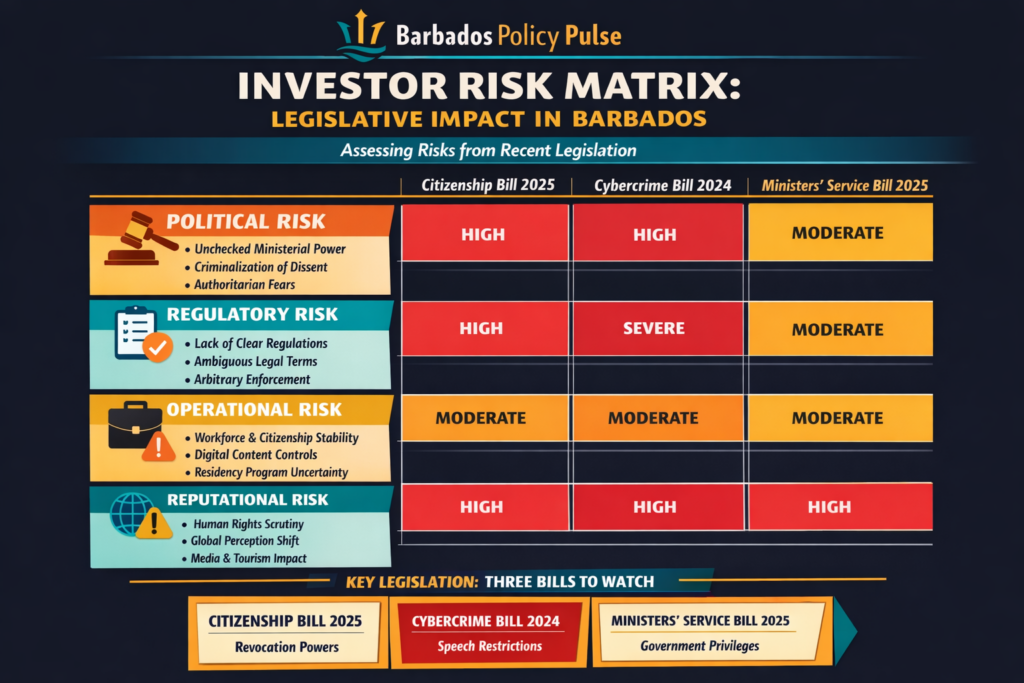
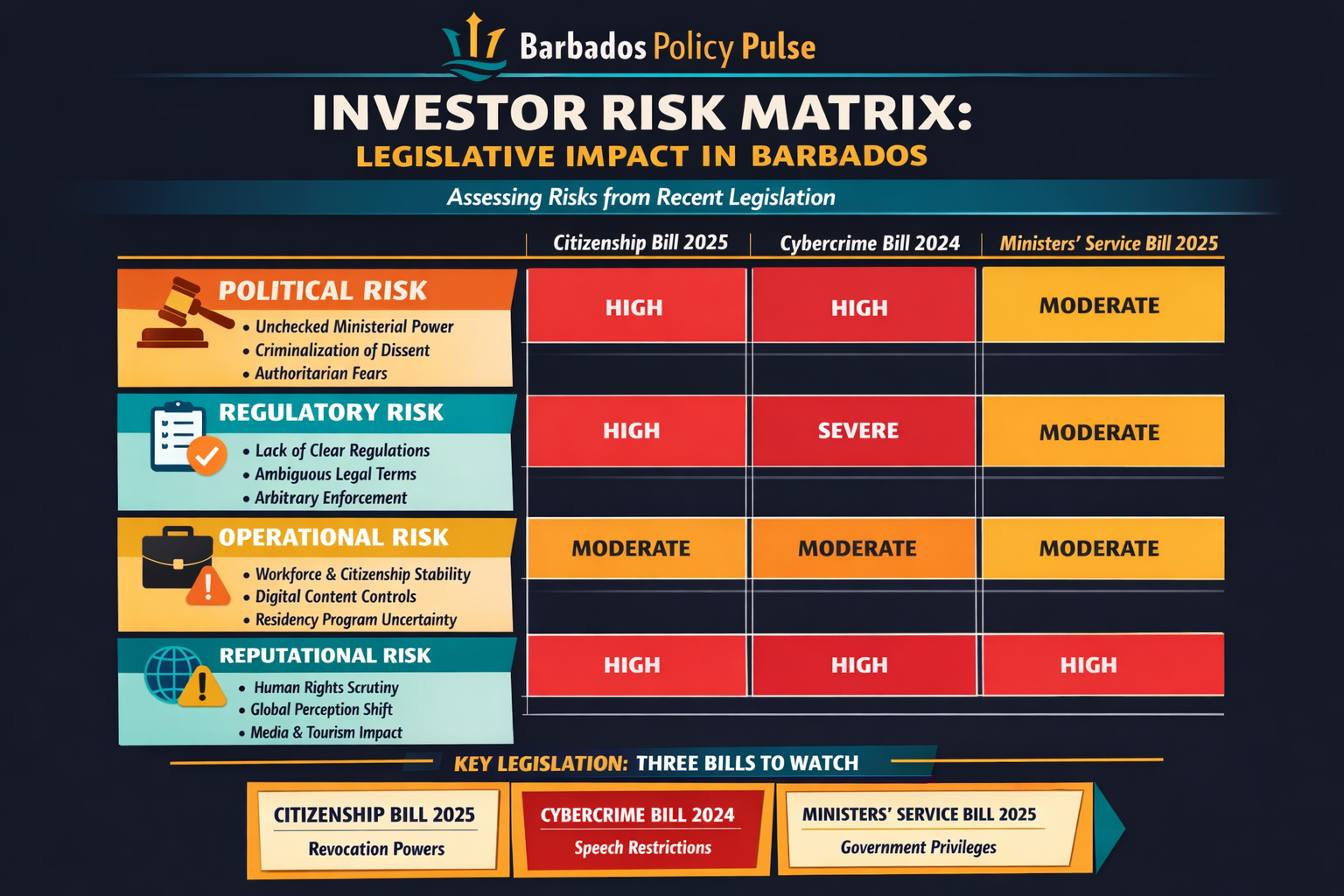
Investor Risk Matrix — Tables 1–5 (Accordion View)
Citizenship Bill 2025 • Cybercrime Bill 2024 • Ministers’ Service Bill 2025
Table 1 Political Risk — Executive power, checks & balances
| Bill | Rating | Key Drivers |
|---|---|---|
| Citizenship Bill 2025 | HIGH | Minister’s discretion “final and not to be questioned”; revocation based on undefined “disloyal speech/acts”. |
| Cybercrime Bill 2024 | HIGH | Criminalizes broadly defined online expression; risk of suppressing dissent and journalism. |
| Ministers’ Service Bill 2025 | MODERATE | Contextually reinforces executive‑centric perception; lower direct political‑risk impact than the other two. |
Table 2 Regulatory Risk — Clarity, consistency, predictability
| Bill | Rating | Key Drivers |
|---|---|---|
| Citizenship Bill 2025 | HIGH | Bar Association cautions against passage without regulations; ambiguity around revocation criteria/appeals. |
| Cybercrime Bill 2024 | SEVERE | Subjective terms (“offensive”, “annoying”, “embarrassing”) create uncertain compliance and liability; punitive penalties. |
| Ministers’ Service Bill 2025 | MODERATE | Primarily administrative; indirect regulatory impact but adds to signal risk when combined with others. |
Table 3 Operational Risk — Workforce, digital ops, permits/residency
| Bill | Rating | Key Drivers |
|---|---|---|
| Citizenship Bill 2025 | MODERATE | Uncertainty for diaspora and expat talent; possible friction in mobility planning and HR pipelines. |
| Cybercrime Bill 2024 | MODERATE | Digital comms & social operations exposed to content liability; added moderation/legal review costs. |
| Ministers’ Service Bill 2025 | MODERATE | Limited direct operational impact; monitor reputational spillover during procurement/public engagement. |
Table 4 Reputational Risk — Human rights, global perception, media
| Bill | Rating | Key Drivers |
|---|---|---|
| Citizenship Bill 2025 | HIGH | Concerns over democratic image and passport standing; diaspora unease about speech‑linked revocation powers. |
| Cybercrime Bill 2024 | HIGH | IACHR scrutiny; global press on speech restrictions and chilling effects. |
| Ministers’ Service Bill 2025 | HIGH | Reinforces narrative of political‑class privilege when viewed alongside other centralizing bills. |
Table 5 Financial / Investment Stability — Contracts, predictability, sector sensitivity
| Bill | Rating | Key Drivers |
|---|---|---|
| Citizenship Bill 2025 | MOD‑HIGH | Appeal‑less ministerial power complicates long‑range planning and pricing of residency/citizenship options. |
| Cybercrime Bill 2024 | HIGH | Media/tech/fintech exposed to content liabilities; potential brand and growth constraints. |
| Ministers’ Service Bill 2025 | MOD‑HIGH | Signal risk for ESG narratives and ratings when triangulated with the other two bills. |