
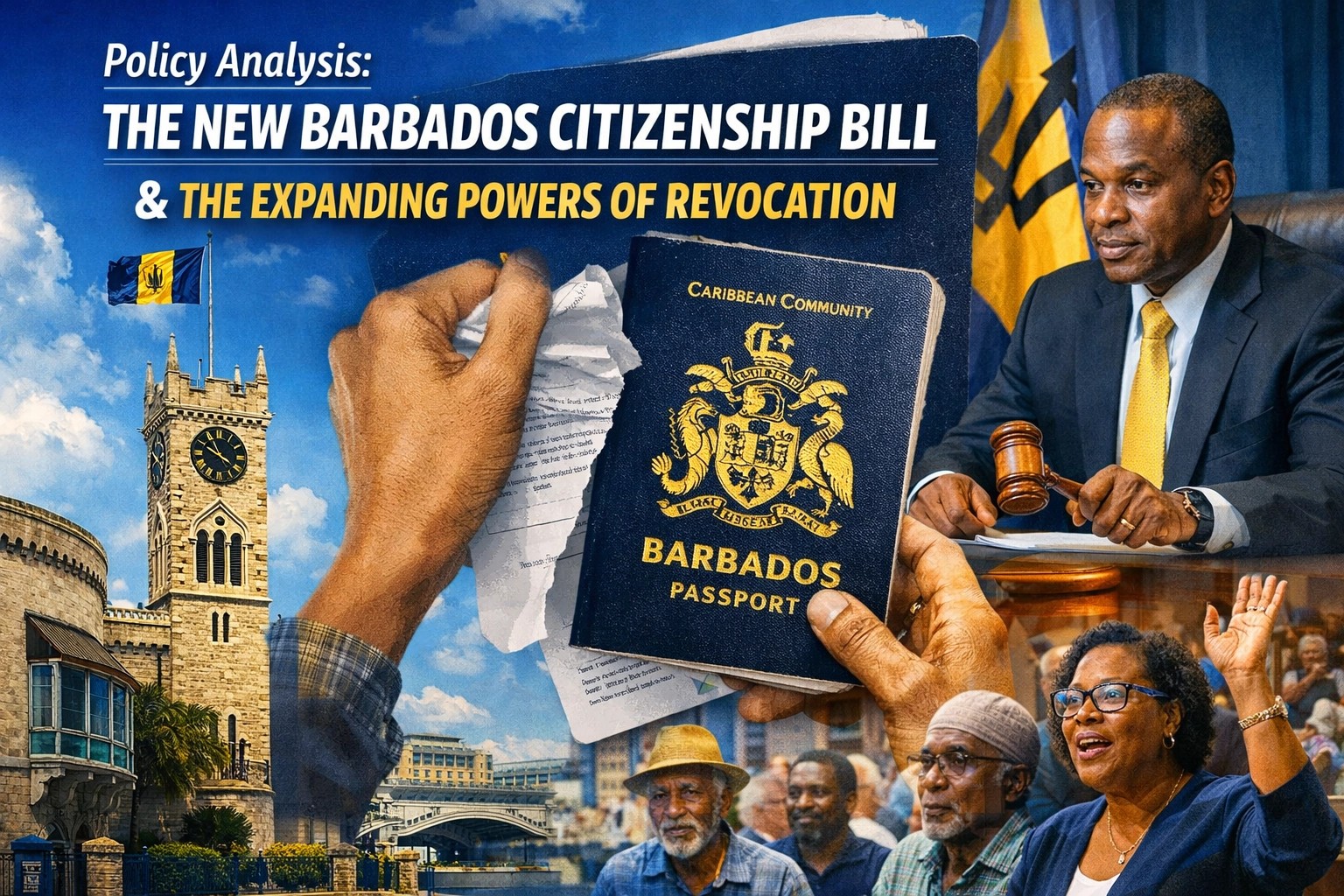
Policy Analysis: The New Barbados Citizenship Bill & the Expanding Powers of Revocation
🔎 Policy Analysis
The New Citizenship Bill & Ministerial Revocation Powers: What Barbadians Need to Know
By Barbados Policy Pulse
🌐 Introduction: A Turning Point in Barbados’ Citizenship Landscape
Barbados is in the midst of redefining who can become Barbadian — and who can stop being one.
The Barbados Citizenship Bill, 2025 proposes the most sweeping reforms in decades, modernizing access to citizenship while simultaneously strengthening the state’s authority to revoke it. While government officials frame these changes as necessary to address population decline and modern migration realities, stakeholders are raising serious concerns about ministerial overreach, vague definitions, and erosion of due process.
This analysis distills what’s changing, why experts are uneasy, and what it could mean for diaspora families, investors, and ordinary Bajans.
1. 🏛️ What the New Citizenship Bill Proposes
The Barbados Citizenship Bill, 2025 revises the entire architecture of citizenship — who qualifies, who keeps it, and who can lose it.
🔹 A. Expanded Eligibility for Citizenship
The Bill widens the net to include:
- Children, grandchildren, and great‑grandchildren of Barbadians born overseas
- CARICOM nationals and others with Immigrant Status
[barbadosdigital.com]
This expansion aligns with national efforts to address population decline and skills shortages.
🔹 B. Strengthened Revocation (“Deprivation”) Powers
An entire section empowers the government to revoke citizenship on grounds including fraud, disloyalty, or actions deemed harmful to Barbados’ interest.
[barbadospa…iament.com]
🔹 C. Minister’s Decisions Declared “Final”
Clause 13 states plainly that the Minister’s discretion cannot be questioned.
This centralizes unprecedented power in a single office. [barbadospa…iament.com]
🔹 D. Revocation for “Disloyal Speech or Acts”
Clause 9(1)(c) allows revocation based on a person’s “speech or acts” if deemed disloyal or disaffected toward Barbados.
The wording is broad, subjective, and potentially open to political interpretation. [barbadostoday.bb]
🔹 E. Birthright Citizens Are Exempt
Importantly, these revocation provisions do not apply to citizens by birth.
[barbadostoday.bb]
2. ⚠️ Why the Bill Is Raising Red Flags
From legal bodies to political parties, skepticism is mounting.
🗣️ A. “Unchecked Power” — Political Stakeholder Concerns
Kemar Stuart of the New National Party warned that the Bill grants “the utmost discretion” to the Minister with no built‑in appeals process or need for parliamentary approval.
[barbadostoday.bb]
He cautioned that such a framework could allow arbitrary or politically motivated revocation.
🗣️ B. Vague Language on Disloyalty
Experts argue that “disloyal speech or acts” is dangerously broad. Stuart called for precise definitions, such as terrorism or treason, to prevent misuse.
[barbadostoday.bb]
🗣️ C. Missing Regulations = Legal Blind Spots
The Barbados Bar Association (BBA) urged Parliament not to pass the Bill without its regulations, noting that citizenship law “lives and breathes” in the regulations.
[nationnews.com]
Without them, implementation would be inconsistent and open to interpretation.
🗣️ D. Constitutional and Rights Concerns
With ministerial decisions labeled “final,” experts worry about alignment with due process protections and constitutional principles.
[nationnews.com]
🗣️ E. Diaspora Anxiety
Diaspora Barbadians eager to reconnect through citizenship worry their newly gained status could later be revoked — even for online speech.
[barbadostoday.bb], [barbadosdigital.com]
3. 📌 What This Could Mean for Key Groups
Here’s how the amendments could affect three major stakeholders.
🌍 A. For the Diaspora: A Door Opens — and a Risk Emerges
1. More pathways, but more vulnerability
While eligibility is easier, diaspora citizens by descent or registration would fall under revocation rules.
[barbadosdigital.com], [barbadostoday.bb]
2. Speech concerns across borders
Public criticism of Barbadian policy — even on social media — could theoretically be interpreted as “disloyal.”
[barbadostoday.bb]
3. A new sense of precarity
Families hoping to reconnect with Barbados may hesitate if citizenship can later be taken away at ministerial discretion.
[barbadospa…iament.com], [barbadostoday.bb]
💼 B. For Investors: Stability Questions in a Changing Legal Landscape
1. Business continuity risks
Foreign investors relying on citizenship to operate or reside in Barbados may view revocation powers as a threat to long‑term planning.
[barbadostoday.bb]
2. Legal uncertainty affects investor confidence
A system where a single minister’s decision is “final” undermines perceptions of stability.
[barbadospa…iament.com]
3. Potential reputational impact on the Barbados passport
Critics warn the reforms could weaken global perceptions of the Barbadian passport — once the region’s highest ranked.
[nationnews.com]
🇧🇧 C. For Bajans at Home: Governance, Rights, and the Social Contract
1. Expanded executive authority
Residents may worry about democratic checks and balances when a Minister’s decisions are beyond challenge.
[barbadostoday.bb]
2. Effects on community ties
If diaspora Barbadians fear revocation, it may reduce remittances, investment, and cultural exchange.
[barbadosdigital.com]
3. Two-tier citizenship perception
While birthright citizens are protected, others are not — potentially creating unequal classes of Barbadian citizenship.
[barbadostoday.bb]
📣 Conclusion: A Crucial Moment for Public Dialogue
The Barbados Citizenship Bill, 2025 represents both opportunity and uncertainty. Expanded access for descendants and migrants aligns with population objectives — but the broad and unchallengeable ministerial revocation powers raise profound legal, democratic, and societal questions.
For diaspora families, investors, and Barbadians at home, the stakes are high. As Parliament reviews the Bill, it is essential that the final legislation balances modernization with constitutional safeguards, protecting both the integrity and the inclusivity of Barbadian citizenship.