

🏛️✨ Anti‑Defection Laws in Barbados: Stability at What Cost?
Barbados is on the verge of a significant parliamentary shift. The Government has announced its intention to introduce legislation that would prevent elected Members of Parliament (MPs) from “crossing the floor”—changing party allegiance or becoming independent after being elected. The announcement was made on February 12, 2026, as Prime Minister Mia Amor Mottley was sworn in for a third consecutive term, with the Prime Minister stating this measure would be among the first bills of the new session. [academia.edu]
On the surface, the proposal is framed as a matter of democratic integrity: protecting voters from having their electoral choices altered mid‑term. In theory, such laws can strengthen party accountability and discourage political opportunism. But laws do not operate in isolation; their impact depends on context. In Barbados today, that context raises serious concerns. There is currently no constitutional or statutory provision that prevents MPs from crossing the floor—and political scientists note Barbados’ system has traditionally allowed such moves without seat forfeiture. [stvincenttimes.com]
📌 The Case for Anti‑Defection Laws — In Theory
Supporters argue that voters primarily elect parties, not individuals. When an MP defects after an election, it can feel like a betrayal of the party mandate. From this perspective, anti‑defection rules are meant to preserve electoral clarity, reinforce party platforms, and ensure that political change occurs through elections rather than individual manoeuvring. These points have surfaced repeatedly in Barbados’ discourse since high‑profile defections in 2018 and 2024. [stvincenttimes.com]
But Barbados is not currently operating in a balanced, multiparty House; it is operating in a context where one party again holds all 30 seats, a fact that intensifies concerns about voice and representation. [ijllr.com]
🧭 Underrepresentation and the Absence of Opposition
Over recent years, Barbadians have voiced concerns about underrepresentation and limited political voice. Those concerns have been magnified by successive 30–0 outcomes that leave the House of Assembly without a formal opposition bench, raising questions about scrutiny, debate, and dissent. Public reaction since the latest election reflects a mix of support and scepticism about anti‑defection, with many citizens explicitly warning that such a law could entrench dominance rather than improve accountability. [milanvaishnav.com]
🔄 Floor‑Crossing as a Democratic Pressure Valve
In highly lopsided parliaments, floor‑crossing—while imperfect—has sometimes functioned as a democratic pressure valve. It allows dissenting voices to emerge, representation to recalibrate between elections, and public sentiment to be reflected when parties evolve or drift. Removing that option in a context where voters already feel disconnected from decision‑making risks intensifying frustration. This is especially significant in a small state like Barbados, where MPs have historically been understood as both party‑affiliated and individually accountable to their constituencies. [stvincenttimes.com]
🗣️ Public Sentiment: Voice, Balance, and Democratic Space
Public reaction over recent years suggests that many Barbadians already feel politically sidelined—particularly in the absence of opposition voices in Parliament. This sentiment has been consistently expressed across call‑in programmes, letters to editors, and community discussions. NationNews’ reporting captures both perspectives: some call for by‑elections upon defection as a question of fairness, while others fear a hidden agenda to maintain absolute power. [milanvaishnav.com]
“People already feel like there’s no real opposition. Taking away the ability for MPs to act independently just makes Parliament feel even more closed.”
— a commonly expressed concern in public forums (call‑in programmes, letters, community meetings)
“Stability is important, but stability without representation feels like silence.”
— recurring sentiment in media commentary and community discussions
Note: The quotes above reflect recurring themes in Barbadian media commentary and public forums and are presented to illustrate patterns of concern rather than attribute individual statements. [milanvaishnav.com]
⚖️ Legal Analysis: Can an Anti‑Defection Law Fit Barbados’ Constitution?
Constitutional starting point: Barbados uses single‑member constituencies in which voters elect individual MPs, and the Constitution does not formally recognise political parties as the legal basis for holding or losing a seat—an understanding acknowledged publicly by the Prime Minister. Any law that makes an MP’s seat contingent on party membership would redefine the representative mandate from constituent‑based to party‑based. That is a constitutional departure unless the Constitution itself is amended. [ijllr.com]
Rights & principles at stake: Anti‑defection provisions restrict MPs’ association and expression, concentrating power in party leadership and narrowing legislative independence. Comparative scholarship documents these effects, particularly in India’s Tenth Schedule and Bangladesh’s Article 70 regimes. [stvincenttimes.com], [jamaicaobserver.com]
Comparative choices:
- Strict models: India, Bangladesh, Pakistan—constitutional rules disqualify defectors; cohesion rises but MP autonomy falls. [stvincenttimes.com], [jamaicaobserver.com]
- Managed experiments: Israel and South Africa—attempts to regulate rather than ban defections, with mixed results. [stvincenttimes.com]
- Norm‑based Western model: UK, Canada, Australia, US—floor‑crossing is legal; consequences are political (loss of posts, caucus expulsion), not loss of seat. [barbadostoday.bb]
Local expert caution: Regional pollster Peter Wickham urges that any floor‑crossing law should not be rushed and ought to be part of broader constitutional reform, warning that such laws are often narrow in effect and easily gamed. [academia.edu]
If Government proceeds, minimum safeguards:
- Place the rule on a constitutional footing, not merely in statute, to avoid conflict with the current member‑centric design. [ijllr.com]
- Use narrow triggers (e.g., confidence/supply) and create independent adjudication before any vacancy is declared. [stvincenttimes.com]
- Protect conscience votes and consider a constituent‑initiated recall as a voter‑driven alternative. [en.wikipedia.org]
🌐 Geopolitical Alignment: What This Signals About Barbados
Adopting anti‑defection legislation moves Barbados closer to South Asian democracies that codify party loyalty into law (India, Pakistan, Bangladesh), and away from Western liberal parliamentary norms where floor‑crossing is legal and managed through political accountability. Analysts and regional coverage underscore that the Mottley administration intends to prioritise this bill early in the term, while also speaking to broader reform (observers, Senate inclusion), which could soften optics but does not change the underlying shift in democratic design. [todayville.com], [stvincenttimes.com], [barbadostoday.bb]
International IDEA’s Global State of Democracy profile notes Barbados performs strongly on representation and participation with no major declines through 2024, underlining why any reform that reduces MP autonomy must be carefully designed to avoid eroding these strengths. [longdom.org]
🚨 RED FLAG: Timing, Constitution, and a Shift Away from Westminster Norms
This was not in the campaign conversation or manifesto—yet it’s the first legislative move of a 30–0 Parliament. In a House with zero opposition, fast‑tracking anti‑defection legislation looks less like modernization and more like power consolidation at the very moment Barbadians are asking for more representation, not less. [academia.edu], [ijllr.com]
❗ Why This Is a Red Flag
- Constitutional mismatch: Barbados’ Constitution is member‑centric, not party‑centric. Voters elect a person to represent a constituency; the Constitution does not treat party membership as the legal basis for holding a seat. Turning party loyalty into a trigger for losing a seat redefines the mandate without first reforming the Constitution. [ijllr.com]
- Process and trust: Announcing anti‑defection as a first order of business—without broad public consultation—undercuts confidence and feeds the perception that the goal is to lock in dominance rather than strengthen democracy. Public reporting shows mixed reactions and growing scepticism about motive. [milanvaishnav.com]
- Democratic direction: This move shifts Barbados away from Western Westminster norms (UK, Canada, Australia, US), where floor‑crossing is legal and dissent is handled through political consequences, not loss of a seat. It instead aligns us with South Asian-style anti‑defection regimes (India, Bangladesh, Pakistan), which legally bind MPs to party leadership and punish dissent. [barbadostoday.bb], [stvincenttimes.com], [jamaicaobserver.com]
🛠️ If Government Proceeds, Do It the Right Way
- Constitution first: Place any anti‑defection rule on a clear constitutional footing, not just in statute—otherwise it collides with the current member‑centric design.
- Narrow triggers & due process: If considered at all, limit to confidence/supply matters, include independent adjudication before a seat is declared vacant, and protect conscience votes.
- People over parties: Consider constituent‑initiated recall as a voter‑driven alternative to party‑triggered disqualification.
- Holistic reform: Embed any changes within a broader constitutional and electoral reform package (public consultations, oversight strengthening, committee system upgrades), rather than a one‑off, high‑velocity bill.
🔚 Bottom Line
Barbadians vote for constituency representatives, not for parties. A law that makes an MP’s seat contingent on party loyalty shrinks your voice, centralizes power in party leadership, and pulls our democracy away from the Westminster tradition that has served Barbados for generations. If the aim is a stronger democracy, start with more representation and accountability—not fewer avenues for dissent.
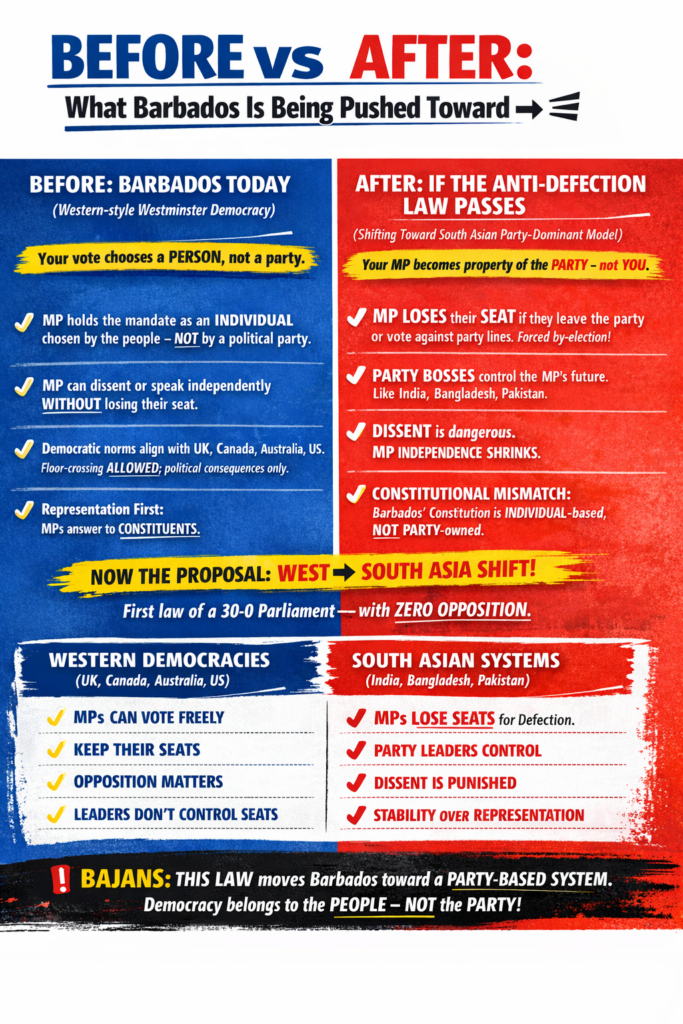
🖼️ Visual Explainer: Before vs After — What Barbados Is Being Pushed Toward
We’ve included a bold infographic contrasting Western Westminster practice (Barbados today) with South Asian anti‑defection regimes (what the proposed law would emulate). Western democracies allow floor‑crossing with political, not legal, consequences (UK/Canada/Australia/US). South Asian regimes legally penalize or disqualify defectors, concentrating power in party leadership (India/Bangladesh/Pakistan). [barbadostoday.bb], [stvincenttimes.com], [jamaicaobserver.com]
🔎 What Citizens Can Ask Their MP—Right Now
- Will you support placing any anti‑defection rule in the Constitution (not ordinary law) with due‑process safeguards? Why or why not?
- Will you back constituent‑initiated recall as a voter‑led alternative to party‑triggered disqualification?
- Will you insist this be part of a wider constitutional reform package with public consultation?
📚 Sources & Further Reading
- Government announcement: anti‑defection to be among first bills in the new term (Feb 12, 2026). [Caribbean Broadcasting Corporation] [academia.edu]
- No current law preventing floor‑crossing in Barbados; expert commentary and context. [Barbados Today] [stvincenttimes.com]
- Public reaction—support and scepticism after third 30–0 sweep; calls for by‑elections vs. concerns about power entrenchment. [NationNews] [milanvaishnav.com]
- Expert caution: legislate only within broader constitutional reform; risks of narrow impact and workarounds. [Barbados Today] [academia.edu]
- PM remarks on party reality vs. constitutional design; Senate inclusion as part of broader reform. [Jamaica Gleaner] [ijllr.com]
- Geopolitical framing and reform package references (observers, inclusivity). [St. Vincent Times] [todayville.com]
- Comparative/academic analysis of anti‑defection (India, Israel, South Africa; party‑leader power concentration). [International Journal of Constitutional Law / Oxford Academic; Columbia Law] [stvincenttimes.com], [jamaica-gleaner.com]
- Strict regimes (Bangladesh Article 70; India Tenth Schedule) and their democratic trade‑offs. [Lawyers & Jurists; Oxford Academic] [jamaicaobserver.com], [stvincenttimes.com]
- Western norm—floor‑crossing permitted, political not legal sanctions (UK/Canada/Australia/US). [Wikipedia overview] [lawyersnjurists.com]
- Barbados democratic baseline—Global State of Democracy profile. [International IDEA] [longdom.org]