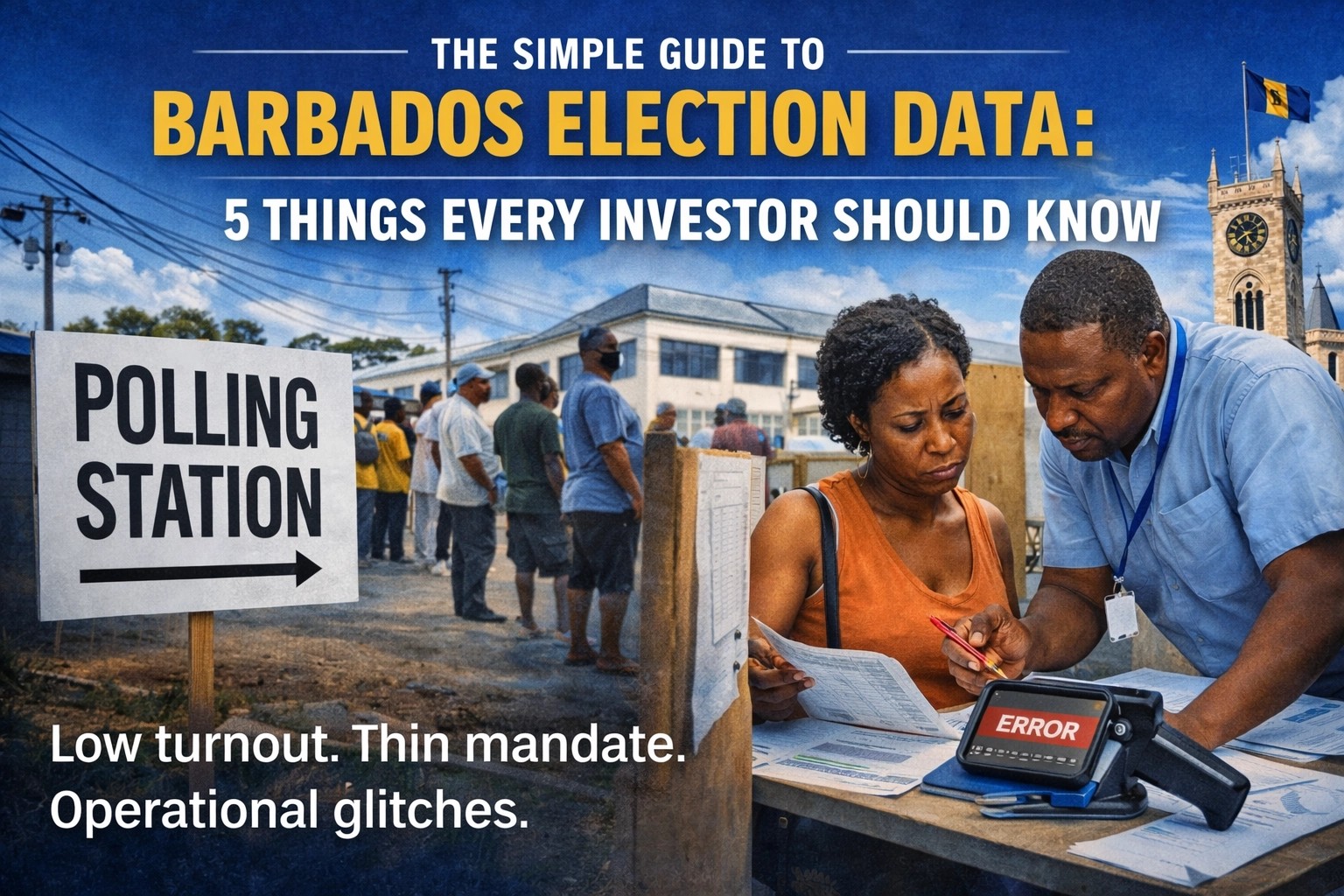
The Simple Guide to Barbados Election Data (2026): 5 Things Every Investor Should Know
Barbados Policy Pulse • February 2026
Barbados’ February 11, 2026 General Election delivered another historic result: the Barbados Labour Party (BLP) secured all 30 seats for the third consecutive time. But for investors, diaspora stakeholders, and policy analysts, the real insight lies not in the sweep itself — but in the numbers behind it, the administrative issues reported, and the governance signals emerging from this cycle.
This expanded analysis breaks down the data, the structural implications, and what investors should be paying close attention to throughout 2026–2027.
1. The Estimated ~30% Voter Turnout: A Critical Indicator of Disengagement
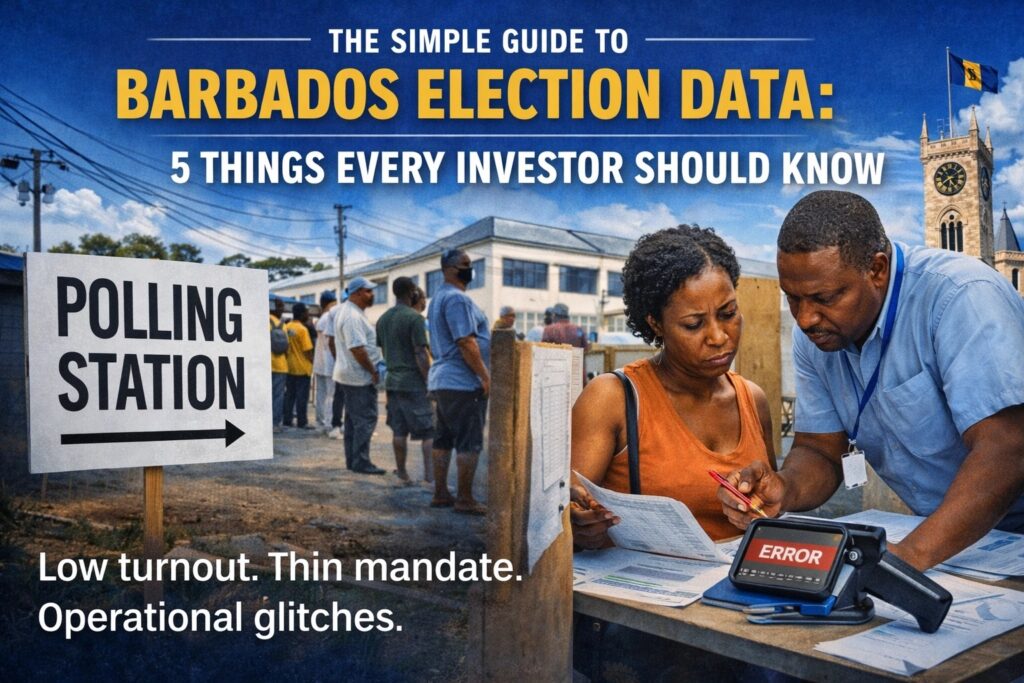
The most consequential figure of this election is the extraordinarily low estimated voter turnout of roughly 30%. Regardless of political affiliation, such a figure points to systemic disengagement, not satisfaction.
Reports throughout the day included:
- Voters absent from the rolls
- Polling station confusion
- Individuals turned away or directed to incorrect locations
- Administrative slowdowns that contributed to delays
These experiences matter. Not because they changed the final result, but because they undermine institutional trust — a core component of political stability and investor confidence.
Why turnout was likely this low
Beyond administrative glitches, several deeper factors may have contributed:
- Democratic fatigue after consecutive snap elections
- Reduced confidence due to repeated 30–0 outcomes
- A public perception that “the outcome is predetermined”
- Economic frustration, which often correlates with political withdrawal
Takeaway:
A turnout collapse of this scale is not a footnote. It is a governance warning sign that investors should not ignore.

2. A Third 30–0 Sweep on Low Turnout Creates a Thin Mandate
The BLP secured:
- 74.1% of the popular vote
- Versus the DLP’s 25.1%
Among those who voted, the support is decisive.
Among the electorate as a whole, the picture is far more complex.
A 30–0 result with only one‑third participation creates what analysts call a thin mandate — high parliamentary control, but weaker social legitimacy.
This dynamic can produce:
- Low public buy‑in
- Growing cynicism
- Public pressure that builds outside Parliament
- A slow increase in long-term governance risk, even if short-term policymaking remains smooth
Takeaway:
A 30–0 sweep on such low turnout is not a sign of national cohesion. It is a structural tension investors must factor into political‑risk assessments.
3. Administrative Glitches Raise Flags About Governance Capacity
Multiple voters reported issues related to:
- Missing names
- Confusion about assigned polling stations
- People being turned away despite presenting identification
Even if these issues did not affect the final result, they highlight potential weaknesses in:
- Public-sector readiness
- Electoral administration
- Digital systems and data integrity
- Basic service delivery reliability
For investors, this matters because election administration often reflects broader institutional performance, including:
- Permitting timelines
- Procurement transparency
- Regulatory enforcement consistency
- Responsiveness of public agencies
Takeaway:
Administrative reliability is a governance metric. The reported issues suggest gaps that investors should monitor over the next year.
4. Voter Apathy Signals Risks to Policy Sustainability
Barbados is known for policy continuity — one of its traditional strengths. But continuity without engagement is fragile.
Low turnout signals:
- Limited enthusiasm for governance direction
- Weak civic participation
- Fatigue with political processes
- Potential resistance to difficult reforms
A government with full parliamentary control can pass legislation quickly.
But long-term policy durability requires public support — especially for reforms involving:
- Taxation
- Land use and zoning
- Public sector restructuring
- Cost-of-living measures
- Infrastructure projects requiring community buy-in
Takeaway:
Voter apathy is a risk factor. Investors should not mistake parliamentary ease for public consent.

5. Investors Should Prioritize Institutional Guardrails Over Seat Count
The seat count is the least important investment signal of this election.
Investors should instead evaluate whether Barbados’ institutional guardrails remain strong, including:
- Regulatory predictability
- Procurement transparency and audit capacity
- Public service efficiency
- Judicial independence
- Strength and credibility of oversight bodies
- A transparent electoral administration
These determine:
- Risk of policy reversal
- Exposure to administrative delays
- Resilience during economic shocks
- The investment climate’s long-term stability
Takeaway:
The real question for investors is not who holds the seats, but whether the country’s institutions remain strong, credible, and able to operate effectively under political strain.
What Investors Should Monitor Over the Next 12 Months
Open the items below to scan the signals that matter most in 2026–2027.
- EBC post‑election review: Whether voter‑roll accuracy, station assignment, and day‑of operations are publicly addressed with corrective actions and timelines.
- Audit & watchdog signals: Clarity and follow‑through from the Auditor General and oversight bodies on procurement and program spending.
- Judicial capacity & independence: Case backlogs, timely adjudication, and perceived impartiality that affect business certainty.
- Licensing & permits: Time‑to‑approval trends and transparency of requirements.
- Digital portals & data integrity: Reliability of business registration, filing, and records systems; reduction in manual workarounds.
- Service responsiveness: Measurable improvements in turnaround times and communication quality across agencies.
- Fiscal & tax policy adjustments: Implications for investment, cost structures, and consumer demand.
- Public sentiment: Organized civic activity, protests, or reform campaigns indicating pressure building outside Parliament.
- Capital project momentum: Execution pace on infrastructure with strong community interfaces where buy‑in is essential.