
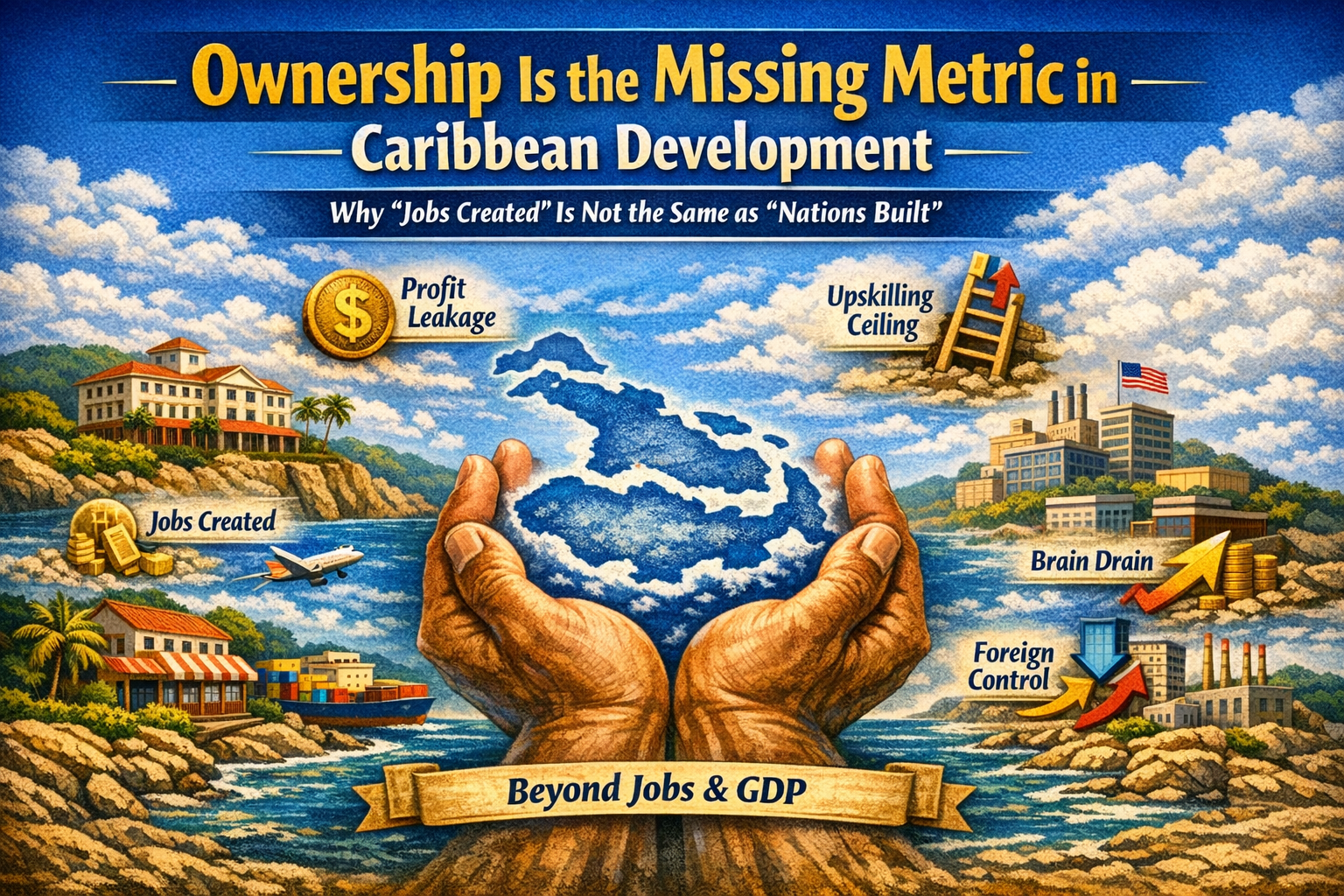
📊 Series Part 3 – Ownership Is the Missing Metric in Caribbean Development
🧭 Why “Jobs Created” Is Not the Same as “Nations Built”
For decades, Caribbean development has been measured using the same familiar indicators:
- Jobs created
- People trained
- Foreign direct investment attracted
- Hotel rooms built
- GDP growth
On paper, these metrics look impressive.
In reality, they often mask a deeper failure.
They tell us how busy people are — not how powerful they are.
What Caribbean development frameworks consistently fail to measure is ownership. And because we do not measure it, we do not prioritize it. Because we do not prioritize it, we continue to design policies that reproduce dependency — even when they are well‑intentioned.
💼 Employment Is Not Empowerment
Let’s be clear: jobs matter.
Income matters.
Stability matters.
But employment alone is not economic freedom.
A country can have:
- High employment
- Continuous training programs
- Growing tourism arrivals
…and still experience:
- Capital flight
- Foreign profit extraction
- Limited local wealth accumulation
- Youth frustration
- Brain drain
Why?
Because labour without ownership does not compound.
Wages are spent.
Ownership accumulates.
This distinction is at the heart of why so many Caribbean economies remain structurally vulnerable despite decades of “development.”
⚖️ The Caribbean Paradox
Here is the paradox we rarely confront honestly:
The Caribbean is one of the most economically active regions in the Global South —
yet one of the least economically empowered.
Tourism, agriculture, creative industries, logistics, and services generate billions annually.
But the commanding heights of these sectors are rarely locally owned.
So growth happens — but wealth does not stay.
This is not accidental.
It is structural.
🚨 What Happens When Ownership Is Absent
When development policy centers employment instead of ownership, several predictable outcomes follow:
1. Wealth Leakage Becomes Normalized
Profits leave the country through:
- Foreign parent companies
- Licensing fees
- Management contracts
- Imported inputs
GDP grows. Local balance sheets do not.
2. Workers Carry Risk, Owners Capture Reward
In downturns:
- Workers are laid off
- Governments absorb debt
- Communities absorb social cost
Owners, often external, remain insulated.
3. “Upskilling” Becomes a Ceiling, Not a Ladder
Training prepares people to:
- Perform better
- Serve longer
- Compete harder
But not to own the systems they operate within.
🧩 Why Ownership Rarely Appears in Policy Metrics
Ownership is missing from development frameworks because it is politically inconvenient.
Measuring ownership forces uncomfortable questions:
- Who owns the land?
- Who controls capital?
- Who sets prices?
- Who captures long‑term value?
- Who benefits when the economy grows?
It also challenges powerful interests — local and foreign — who benefit from the status quo.
So instead, policy focuses on outputs that look neutral:
- Training numbers
- Participation rates
- Employment statistics
These are easier to celebrate and safer to defend.
📏 What We Should Be Measuring Instead
If Caribbean nations are serious about transformation, ownership must become a core development indicator.
That means tracking:
- Percentage of GDP generated by locally owned enterprises
- Local equity participation in major sectors
- Number of businesses that transition from:
- Sole trader → company
- Company → exporter
- Exporter → multinational
- Retention of profits within the domestic economy
- Intergenerational business continuity
These metrics reveal whether development is extractive or regenerative.
🌱 Ownership Changes Behaviour — At Every Level
When people own assets, everything changes.
- Workers think long‑term
- Communities protect infrastructure
- Innovation increases
- Productivity improves
- Social cohesion strengthens
Ownership creates stakeholders, not just participants.
And nations built on stakeholders are more resilient than nations built on labour alone.
🔁 Reframing the Development Question
The central question Caribbean policymakers should be asking is not:
“How many jobs did this initiative create?”
But rather:
“Who owns what after this initiative is complete?”
If the answer is:
- Mostly foreign entities
- A small local elite
- Or no one locally at all
Then whatever was built will eventually extract more than it gives.
🧠 A Hard Truth — and an Opportunity
Caribbean nations are not underdeveloped.
They are under‑owned.
This distinction matters because it shifts the solution:
- From more training → to more equity
- From more jobs → to more assets
- From participation → to control
Development does not fail because Caribbean people lack skill or work ethic.
It fails because the system was never designed for broad-based ownership.
That design choice can be changed.
🏁 Final Thought
A nation is not truly built when its people are busy.
It is built when its people:
- Own
- Decide
- Accumulate
- Pass something on
Until ownership becomes a primary metric of success, Caribbean development will continue to look impressive — and feel unsatisfying.
Growth without ownership is motion without direction.